
If you’ve ever been curious about the origins of civilizations in America, you’ve likely come across the name Caral. It’s no surprise. Caral is not only considered the oldest civilization on the American continent, but it has also challenged many ideas about how and where the first organized societies in the world emerged. From the first time I heard about Caral, I was amazed to think that while Egypt was building its pyramids, a monumental and advanced city was already flourishing in South America.
In my experience as a writer and history enthusiast, I’ve noticed that many people are still unaware of the significance of this archaeological site located in Peru. What stands out to me the most is how Caral managed to develop without the use of ceramics or weapons, prioritizing social organization and astronomical knowledge. In this article, I want to share with you, in a friendly and clear manner, everything you need to know about Caral: its location, unique architecture, surprising culture, and why it is considered the cradle of Andean civilization.
Contents
- 1 Geographical location
- 2 Characteristics of the geographical environment
- 3 Etymology of the name Caral
- 4 Discovery and archaeological research
- 5 Antiquity and dating
- 6 Periods of occupation
- 7 Sacred and urban architecture
- 8 Social organization and population
- 9 Cultural expressions
- 10 Importance as the cradle of Andean civilization
- 11 Unique features of Caral culture
- 12 Frequently asked questions about Caral
Geographical location
Caral is located in the Supe River valley, on the central coast of present-day Peru, about 200 kilometers north of Lima. This site is very close to the Pacific Ocean, although it is separated from the coastline by about 25 kilometers. The exact area is situated in the district of Supe, Barranca province, Lima region. In my opinion, its strategic location between the sea and the Andes allowed them to take advantage of both marine and agricultural resources.
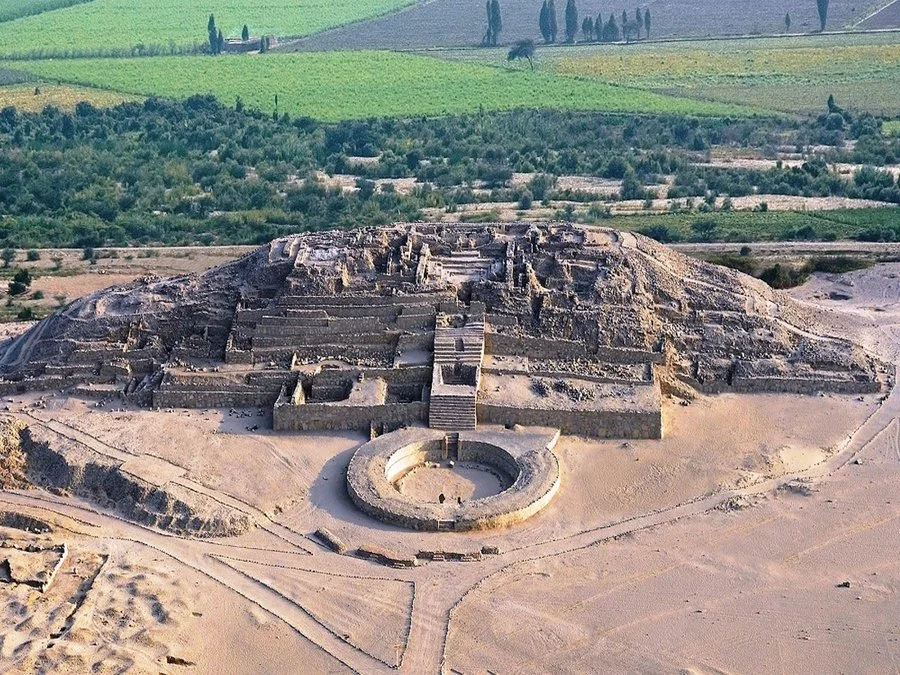
The image shows the impressive Caral archaeological complex, surrounded by the arid valley and with access to the fertile Supe River.
Characteristics of the geographical environment
The natural environment of Caral is quite unique. It is an arid valley with scarce rainfall, where sandy soils and a dry climate prevail almost all year round. However, the Supe River provides fresh water that makes agriculture possible in the midst of the coastal desert. I’ve read that this combination of extreme dryness and river irrigation was key to intensive agricultural development and the stability of the city.
- Climate: Arid, mild during the day and cold at night
- Resources: Access to fresh water, cultivable soils, and proximity to the sea
- Landscape: Plain interspersed with low hills and natural mounds
As I understand it, this geography fostered community cooperation to manage water resources, which is essential for any complex society.
Etymology of the name Caral
The name “Caral” comes from the main site where archaeological remains were found. Although there is no exact translation or absolute consensus on its meaning, it is believed to be related to local pre-Hispanic terms. In fact, the term was adopted by archaeologists from the name used by the current inhabitants of the valley.
Discovery and archaeological research
The modern history of Caral began in the 1970s, but it was at the end of the 20th century that it gained true relevance. Archaeologist Ruth Shady Solís led systematic excavations starting in 1994. I remember reading interviews where she recounted how initially few believed that this site was so ancient. Everything changed when radiocarbon analyses confirmed its millennial age.
| Lead researcher | Year of start |
|---|---|
| Ruth Shady Solís | 1994 |
These efforts revealed a complex urban center with monumental pyramids, circular plazas, and a sophisticated social organization.
Antiquity and dating
Caral is considered the oldest civilization in America because its remains date back approximately between 3000 and 1800 B.C., according to carbon-14 tests performed on plant fibers and organic remains found in its constructions. To put it in perspective, while Stonehenge was just being built in Europe, Caral was already a prosperous city.
- Earliest verified dating: Around 3000 B.C.
- Methods used: Radiocarbon analysis (C14)
Periods of occupation
The main settlement of Caral peaked between 3000 and 1800 B.C., although recent research suggests continuous or intermittent occupations until later dates. There were likely early phases of establishment followed by urban expansion and then a gradual decline, but always within the Andean pre-ceramic period.
Sacred and urban architecture
One of the things that impresses me most about Caral is its monumental architecture. The urban center consists of pyramidal platforms, sunken plazas, and large ceremonial spaces. All of this was built using materials such as stone, clay, and a technology called shicra (which we will discuss later).
Pyramidal public buildings
The main pyramids are enormous stepped platforms that served as temples or ceremonial centers. It is not an exaggeration to say that they rival in size with some early Egyptian pyramids.
Caral Alto Sector
This area contains the most imposing structures, such as the Great Pyramid (about 28 meters high) and circular plazas associated with public rituals. Speaking of this, it is impossible not to feel awe at the scale achieved without metal tools.
Caral Bajo Sector
This sector houses smaller but equally significant buildings: secondary temples, smaller plazas, and administrative areas.
Residential architecture
Although they were not as flashy as the pyramids, the houses show clear social differentiation: from large multifunctional complexes to exclusive residences for officials or elites.
Multifunctional residential complexes
These were large homes with internal patios, where several families or groups related by work or kinship likely lived.
Officials’ residences
Often located near ceremonial or administrative centers. These houses were larger and had better construction finishes. In my opinion, this reflects a well-established hierarchy within Caral society.
Social organization and population
The Caral society was clearly stratified. There was a ruling elite responsible for religious rituals and administration, while the majority engaged in agricultural work, construction, and fishing. According to recent archaeological estimates, the total population may have reached between 3,000 and 5,000 inhabitants at its peak.
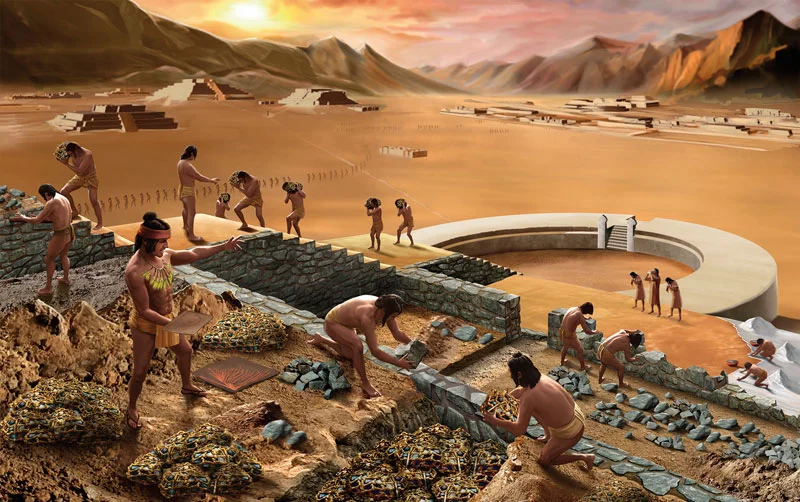
The illustration shows everyday activities: farmers by the Supe River, families building homes, and priests in public ceremonies.
Cultural expressions
Despite not having developed ceramics or conventional writing, Caral amazed the world with artistic expressions and technological innovations unique for its time.
Clay figurines
Hundreds of small human figures molded in clay have been found in ritual contexts. Many lack defined facial features; they likely represented mythical characters or social symbols.
Quipu system
I am fascinated that quipus were already used in Caral: knotted cords used as a mnemonic system for keeping accounting or administrative records. Although quipus are associated with the Incas, here we find their first documented precedents in America.
Shicra technology
Shicra is a construction technique unique to the Andean region: it consists of woven bags filled with stones. They were used to stabilize walls and platforms during monumental public works. I am excited to think that this ingenuity allowed for the construction of such resilient structures thousands of years ago.
Musical instruments
Flutes made from pelican and deer bones, as well as marine conch horns (pututos), have been found. In my personal opinion, this demonstrates the importance of sound in both religious ceremonies and daily life.
Cotton textiles
Although poorly preserved due to the arid climate, fragments of textiles woven from native cotton have been recovered. These fabrics show simple patterns but reveal an early mastery of textile art in the Andean region.
Astronomical knowledge
Diverse architectural alignments suggest an advanced understanding of solar and lunar movements. The main buildings are strategically oriented towards key points on the horizon; they were likely used to mark solstices or important agricultural events.
Importance as the cradle of Andean civilization
There is no doubt: Caral represents the starting point for all subsequent Andean cultures. It was a pioneer in planned urbanism, communal water management, and unprecedented technological innovation for that time. Even international specialists have recognized its universal value by declaring it a UNESCO World Heritage site.
Unique features of Caral culture
- They did not develop weapons or clear evidence of internal warfare
- Growth based on peaceful trade and regional exchange
- Surprising absence of ceramics despite urban complexity
- Central role of women in religious rituals (according to some found figurines)
- Sophisticated urban planning guided by astronomical principles
Frequently asked questions about Caral
- Why is Caral considered the oldest civilization?
Due to its reliable radiocarbon dating (around 3000 B.C.) and its advanced urban development before any other known city in America. - What is Caral’s importance today?
It is key to understanding the origins of American civilizations and serves as inspiration for studies on sustainability and early urbanism. - Can the archaeological site be visited?
Yes, there are guided routes from Lima to the site; I personally recommend going early to avoid the intense midday heat. - What sets Caral apart from other ancient cultures?
Its development without internal wars or advanced ceramics; it was also a pioneer in monumental architecture based on social cooperation. - Have any royal tombs or mummies been found?
So far, no royal tombs or complete mummies directly associated with the main site have been discovered.